Retail Pre-Shift Huddle: Build It Backward From One Number
Most pre-shift meetings are a checklist nobody remembers by Thursday. The ones that change a shift start with one number pulled from yesterday's sales.
Nine forty-two on a Tuesday. Doors open at ten. The manager is standing by the register reading off her phone: Sarah's on the floor, Miguel's on register, restock the end cap by the door, don't forget to mop the stockroom before close, everyone wear a name tag today. Four people nod. Two are checking their phones under the counter. By the time she says "any questions," nobody has heard a word since "Sarah."
A retail pre-shift huddle needs one thing this list doesn't have: something that changed since yesterday. A chore list read out loud stops landing by the third day a team hears it. If you run the floor, you already feel the drill going flat. If you own the place, you're paying five minutes of payroll across every seller, every shift, for a briefing that changes nothing about the next four hours. If you sell, you tuned out before the second sentence, because none of it was new.
Why the checklist huddle dies by day three
You stop hearing the fridge compressor after a week. The same thing happens to "restock the end cap" by day three: it's true, it's already on the schedule, and there's no reason to hold onto hearing it twice. Nothing said in the huddle predicted anything that happened on the floor that day, so nothing said in the huddle gets remembered on the floor the next day.
Gallup's research on manager communication found employees whose managers hold regular meetings with them are almost three times as likely to be engaged as employees whose managers skip them. That's real, and it argues for running the huddle every shift instead of some shifts. It doesn't argue for what you say once everyone's standing there. The study measured whether the meeting happened, not whether it had anything new in it, and a five-minute readout of the same three chores can hit that same regularity and still put people to sleep by day three.
Gallup's broader research found business units in the top quartile of engagement outperform the bottom quartile by 23% in profitability and 18% in sales productivity. A huddle won't move that number on its own. It's one of the few levers a shift manager controls directly.
Build it from a different starting point: what happened yesterday that changes what someone should do in the next four hours.
What should a retail pre-shift huddle actually cover?
A retail pre-shift huddle should carry one specific, current fact pulled from the last day or week of sales: the item that almost sold three times but didn't, the objection a seller finally cracked with a new line, or the SKU that's two units from a stockout. State the number, give thirty seconds of context, and say what to do about it for the next four hours. Assignments and chores belong on the schedule and the whiteboard, not the huddle.
Say three customers asked about wash instructions on the merino sweater this week, and none of them bought it. That's the huddle: "The care question is killing the merino. Machine wash cold, lay flat to dry. Say it before they ask." Ninety seconds, and everyone on the floor today walks out with one more sentence in their pocket than they had yesterday. That's different from being reminded to wear a name tag.
Build the huddle backward from one number
Near-misses like the merino line don't show up in a sales report, because nothing sold. They show up if you build a place to write them down: a pad by the register where anyone logs the item and the question whenever a customer puts something back and walks. By close, it's a tally: three "wash instructions" entries in a week is the number the huddle wants.
Spend five minutes with yesterday's close before you open your mouth, or the last seven days if this is a weekly habit rather than a daily one. That's where the tally pad, the sales numbers and the stock ledger all live.
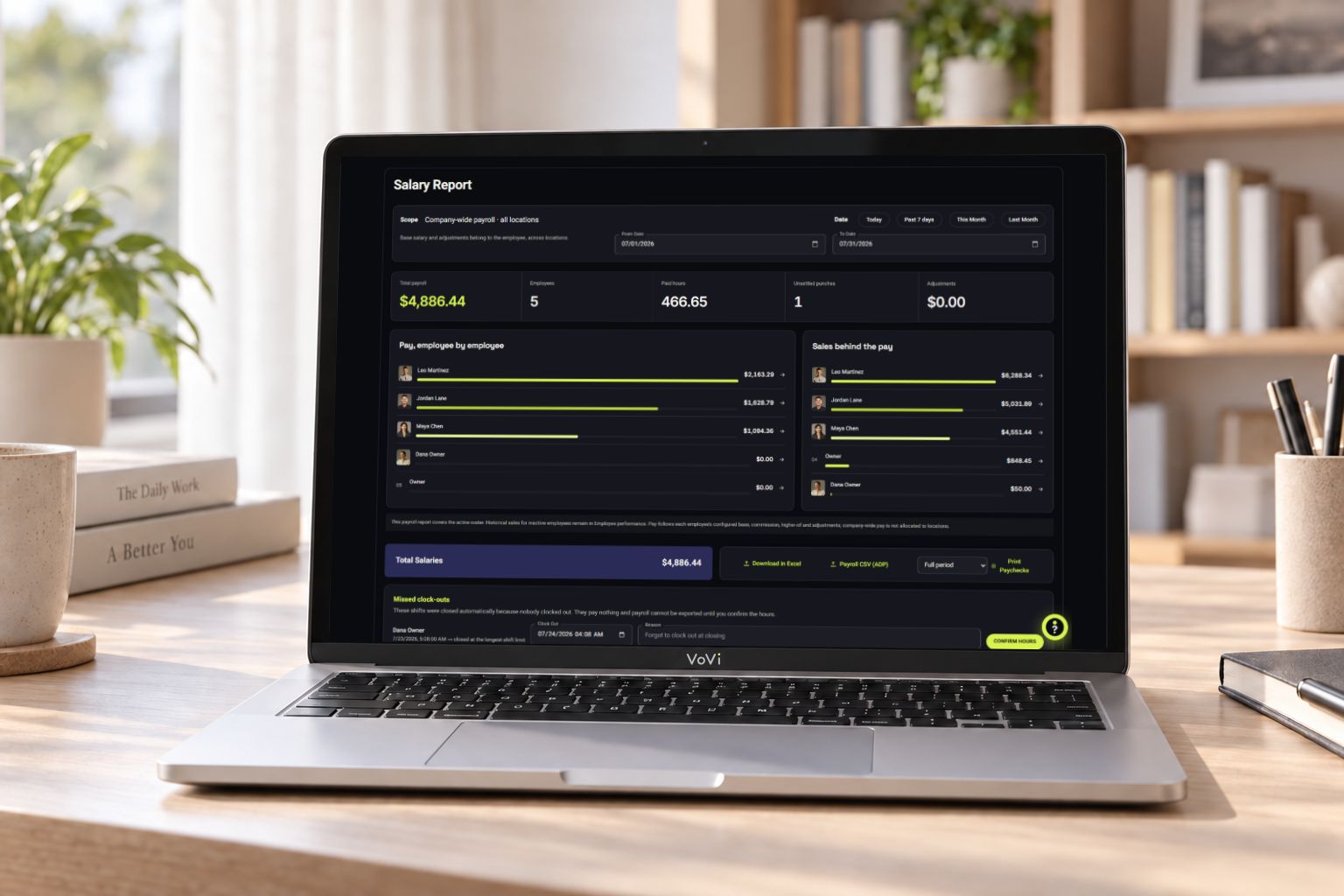
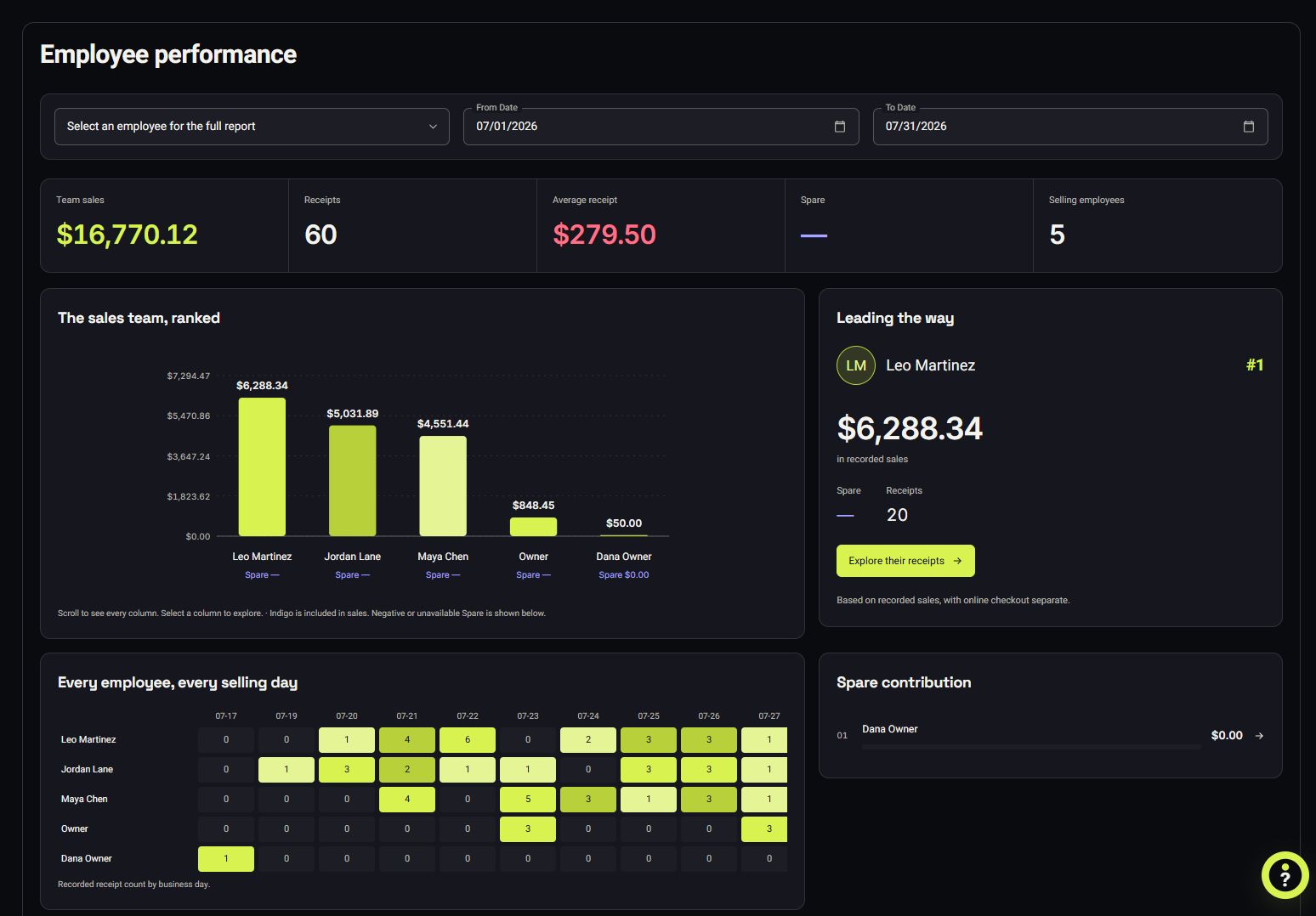
If your point-of-sale system breaks sales down by seller without you building a report first, the win is usually sitting there before your coffee's done. In VoVi that view is on the dashboard by default. If yours doesn't do this automatically, export yesterday's transactions to a spreadsheet and sort by seller: two minutes, once a day, and you have the same number.
The shortage side works the same way if your stock ledger throws a low-stock alert on its own. If yours doesn't, we've laid out the reorder point formula that replaces a hunch with a number.
Keep it under five minutes
Five minutes is generous. If you can't say the number, the context and the ask in ninety seconds, you've drifted back into writing an agenda. Stand up. Skip the clipboard and the laptop; you don't need either for one fact.
If your shifts don't overlap at all, the huddle shrinks to a note instead of a circle: one line taped to the register or dropped in a group message before the next person clocks in. Shorter, not skipped.
This works best when the outgoing and incoming shift can stand in the same room for two minutes. Check the handoff against the hours you trade, not the rota: why your busiest hour isn't the hour you think it is.
A time-sensitive operational note (a delivery arriving mid-shift, a manager out sick) gets one line and then you move on. It doesn't get to expand into the whole huddle just because it showed up the same morning.
The failure mode is a huddle that creeps a minute longer every week because cutting the item that used to matter feels like a demotion. Cut it. Saying a solved problem again is the checklist problem coming back through the side door.
Let someone other than you run it
Have the seller who found the fix say it herself. If someone cracked the line that finally moved the merino sweaters, her words land harder with the rest of the floor than the same sentence read by a manager. It also teaches sellers to notice their own numbers instead of waiting for someone to hand them a script, which is the same instinct behind commission that rewards what a seller closed instead of the shift she happened to work. We've argued that case here: why paying flat commission rewards whoever got Saturday.
Rotating who talks does something else. It shows the floor you read their numbers. A seller who delivered a working line last week is more likely to be listening for the next one this week.
Don't let the huddle calcify
Retire a line once it's stuck. When every seller says "machine wash cold, lay flat" without being asked, find the next number. A huddle that repeats a solved problem is the checklist huddle wearing a different item. The value of the format is that it's current. Let it go stale and the team stops listening for the same reason the old version failed.
Takeaways
- Build the huddle from one specific number pulled from yesterday's or last week's sales: a near-miss, a win, or a shortage.
- Assignments, restocking and dress code belong on the schedule and the whiteboard. If it doesn't change what happens in the next four hours, it doesn't belong in the huddle.
- Cap it at five minutes, and treat ninety seconds as the real target. Stand up; skip the clipboard and the laptop.
- Let the seller who found the win deliver it. Peer credibility lands harder than a manager reading a script.
- Retire a point the moment it's stuck. A repeated solved problem is the old checklist huddle in disguise.
Common questions
What do you do when the number is bad news?
Take it off the floor. If the number points at one seller (a return rate, a missed close), handle it as a one-on-one after the shift. The huddle stays aimed at something the whole team can act on today.
Do you huddle on a two-person shift?
Yes, just smaller. There's no room for a circle with two people, so the huddle becomes a sentence handed off at the register: "the wash question is killing the merino, use the line." It's the same information, just handed off in passing.
Should you huddle on the same number two days running?
Only if nobody used it. If a line went unsaid on the floor yesterday, repeat it once and ask the team why it didn't land. Two days running without anyone using it means the line itself needs work.