Retail Commission Structure: Stop Paying for Saturday
Flat commission on gross sales pays your team for the shift they were handed, not the selling they did. A better plan, and the five ways sellers will game it.
Two sellers, one shop. The one scheduled Saturday afternoons clears $340 in commission. The one who works Tuesday mornings, knows the range cold and sells better, clears $95. Eventually somebody says it out loud in the back room, and a manager has to defend a retail commission structure that was never built to answer the question being asked.
A flat percentage of gross sales is the default plan in independent retail. It is also the worst one in common use, because it pays people for conditions they do not set and quietly penalizes them for the ones they do.
The schedule is the real pay plan
Under flat commission, footfall decides earnings. Whoever is on the floor when the mall fills up outsells whoever is on at 10am on a wet Tuesday, and no amount of skill closes that gap. The person writing the schedule is writing the paychecks.
Sit with that: most of the unfairness arguments in your stockroom are scheduling complaints wearing a commission costume. Sellers work this out fast, then compete for shifts instead of for customers, and you have accidentally built a plan that rewards politics.
The second flaw is quieter and costs more. Flat commission pays out on discounted sales too. A seller who drops fifteen percent to close still gets paid — less, but paid — while you absorb the whole cut. The fastest route to commission is giving away margin that was never theirs to give. Treat a full-price sale and a caved one the same, and the floor will work out which is easier.
A retail commission structure that pays for what they control
Split the list in two. Things a seller controls: items per transaction, average ticket, conversion on the customers they actually engaged, margin held above your floor, and whether a return walks out as an exchange or a refund. Things they do not control: door count, weather, the promo calendar, which shift they were handed.
Pay on the first list, and rank on rates rather than totals: attachment rate beats attachment count, average ticket beats total tickets. A quiet shift can win on rates. It can never win on volume, which is precisely why the Tuesday seller stopped trying.
Rates need a source of truth, and most owners find their system will not hand them one. Items per transaction and average ticket usually mean exporting sales once a month and building the columns yourself: total line items divided by transaction count, then net sales divided by transaction count. Do it anyway — a number you worked out by hand beats a number everybody argues about.
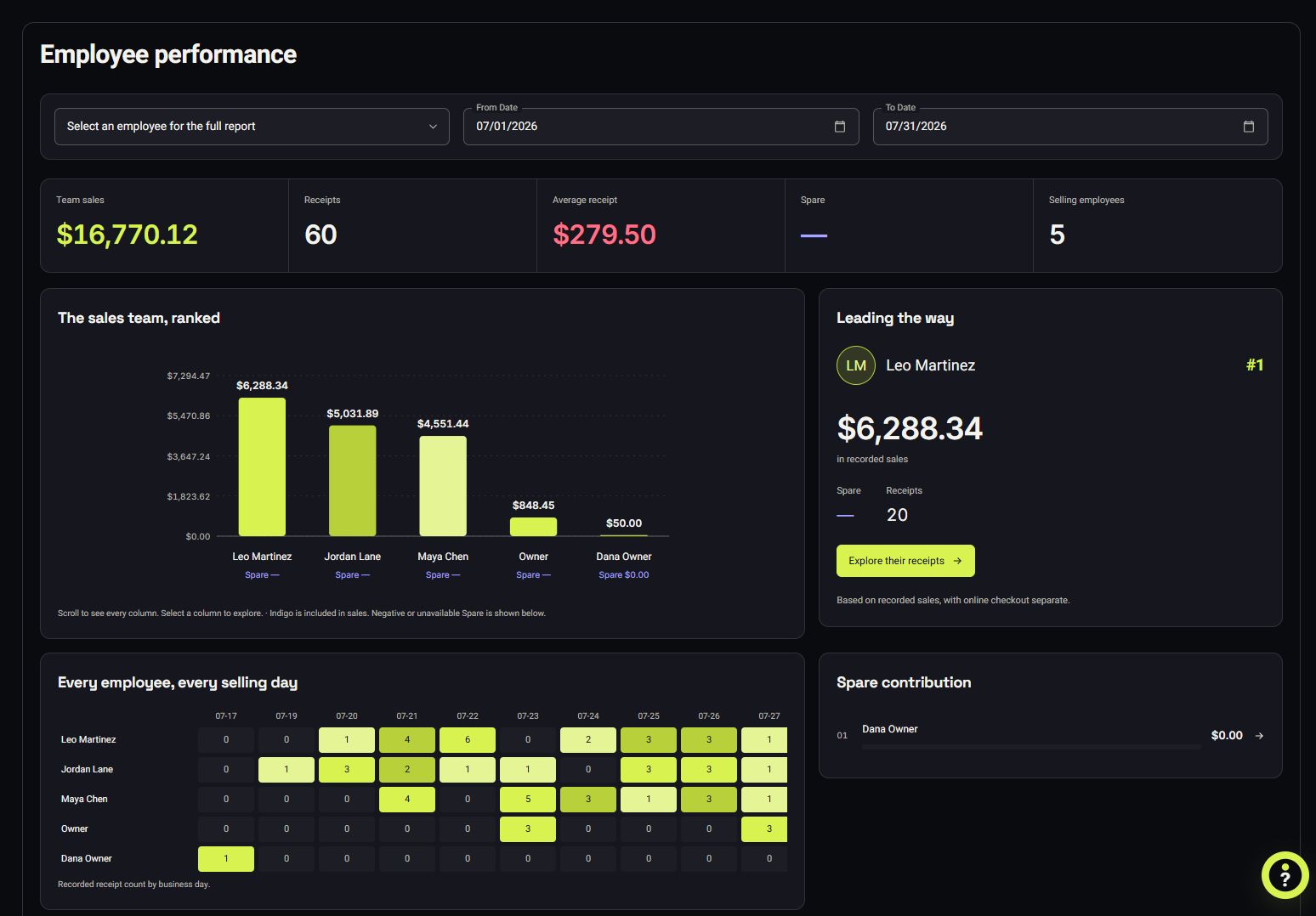
The discount half is easier to automate, because it happens at the register. If the register enforces your floor — VoVi sets a minimum price per product, tracks per seller how much of that negotiation room each one gave away versus kept, and flags any sale that went under the floor with the name of whoever approved it — then discount discipline stops running on trust. Read the override report first. The names cluster, every time.
On a single-staffed cart it matters more, not less: there is no second seller to normalize against, so rates are your only honest comparison across shifts — worth settling early if you are setting up a kiosk or mall cart.
Last test, and the one most plans fail: can a seller work out what they just earned while still standing at the register? If the formula needs a spreadsheet and a payroll cycle, it is a bonus, not an incentive. If it pays a few dollars a week against an hourly base, it is a rounding error. Neither changes what somebody says to the next customer through the door.
Every metric you pay for gets gamed
Goodhart's law puts it cleanly: when a measure becomes a target, it ceases to be a good measure. On a sales floor that is not an abstraction. It is a specific person finding a shortcut within two weeks, and you can usually predict which. Build the guardrail before you announce the plan, not after the first pay run.
| What you pay on | How it gets gamed | The guardrail |
|---|---|---|
| Units sold | One basket gets split across two transactions so the unit count climbs | Measure items per transaction, not raw units |
| Average ticket | Sellers duck the customer holding one cheap thing, or hand them off to whoever is nearest | Pair it with conversion, so avoiding a customer costs them |
| Gross sales | Discount to close, because a smaller commission beats no commission | Commission on margin, or only on price held above a floor |
| Attachment rate | Junk items rung up alongside the sale and returned the following week | Claw back on returns inside 30 days, and say so on day one |
| Conversion | Engagements they expect to lose quietly stop getting logged | Log engagements at the door or at the register, not from seller memory, and spot-check |
None of that means your team is dishonest. They respond to what you actually pay for, which is the only reliable definition of what you want. Write the failure mode next to every metric before you publish the plan. If you cannot think of one, you have not thought about it hard enough.
Build that floor off real gross margin, after the card fee, because what a card sale actually costs you is part of the number rather than a footnote to it.
The overtime rule that catches commission plans
One legal note, and I am not your lawyer — take this to one. Under Section 7(i) of the Fair Labor Standards Act a commissioned employee can be exempt from overtime, but only when all three conditions hold at once: the employee works in a retail or service establishment; their regular rate of pay exceeds one and a half times the applicable minimum wage, federal or state, whichever is higher, for every hour worked in any week in which overtime hours are worked; and more than half of their total earnings in a representative period come from commissions. Tips never count as commissions. The Department of Labor's fact sheet on commissions in retail sets it out in full.
The practical trap is the third condition. More than half means commission has to be the larger part of the paycheck, not merely a decent chunk of it. Work it through: the Bureau of Labor Statistics put the median hourly wage for retail salespersons at about $16.62 in May 2024. Forty hours at that rate is roughly $665 of total pay for the week, and under 7(i) more than half of that has to be commission.
Half of $665 is about $333, so on a one percent plan that is one person ringing upwards of $33,250 in a week. Illustrative numbers, not yours, and the statute measures over a representative period of at least a month rather than a single week. But the shape holds at any scale. Almost no independent store puts that volume through one seller, so almost every owner who thinks the exemption covers them is wrong.
If nobody can see the number, it changes nothing
Ask three sellers what they earned in commission this week. If none can tell you within a few dollars, the plan is not motivating anything on the floor — it is a surprise that arrives on payday. Invisible incentives are just deferred pay.
Pay it monthly at the latest, weekly if you can, and post the numbers where the team can see them. Rates, not totals, on that board. Some comes out of the end-of-day and commission reports, some you write up by hand; the board does not care which. An owner who will not show the leaderboard usually does not trust it, and the team can smell that from across the counter.
Contests are a separate tool, not a substitute. A contest shifts one behavior for two weeks; commission sets the baseline all year. Run both on the same metric and you cannot tell which is doing the work. Stacking a prize on something people already do willingly can also flatten the motivation that was there — the overjustification effect. Give the contest a metric commission does not already pay for.
What to change first
- Rank sellers on rates, never on totals. A Tuesday morning can win on attachment rate; it can never win on volume.
- Pay on margin held above a floor rather than gross sales, or you are funding the discounts that are costing you.
- Write the predicted failure mode beside every metric before you announce the plan, and announce the guardrail with it.
- The 7(i) overtime exemption needs all three conditions at once, and the hard one is commission being more than half of total earnings. A token one percent never gets there.
- Post the numbers monthly at the latest. A number nobody sees changes nobody's behavior.
Run one test on the plan you already have. Pull last month's figures and ask whether the person who sold best took home the most. If the answer turns out to be the person who was given the best shifts, you do not have a commission plan. You have a schedule with a percentage stapled to it.