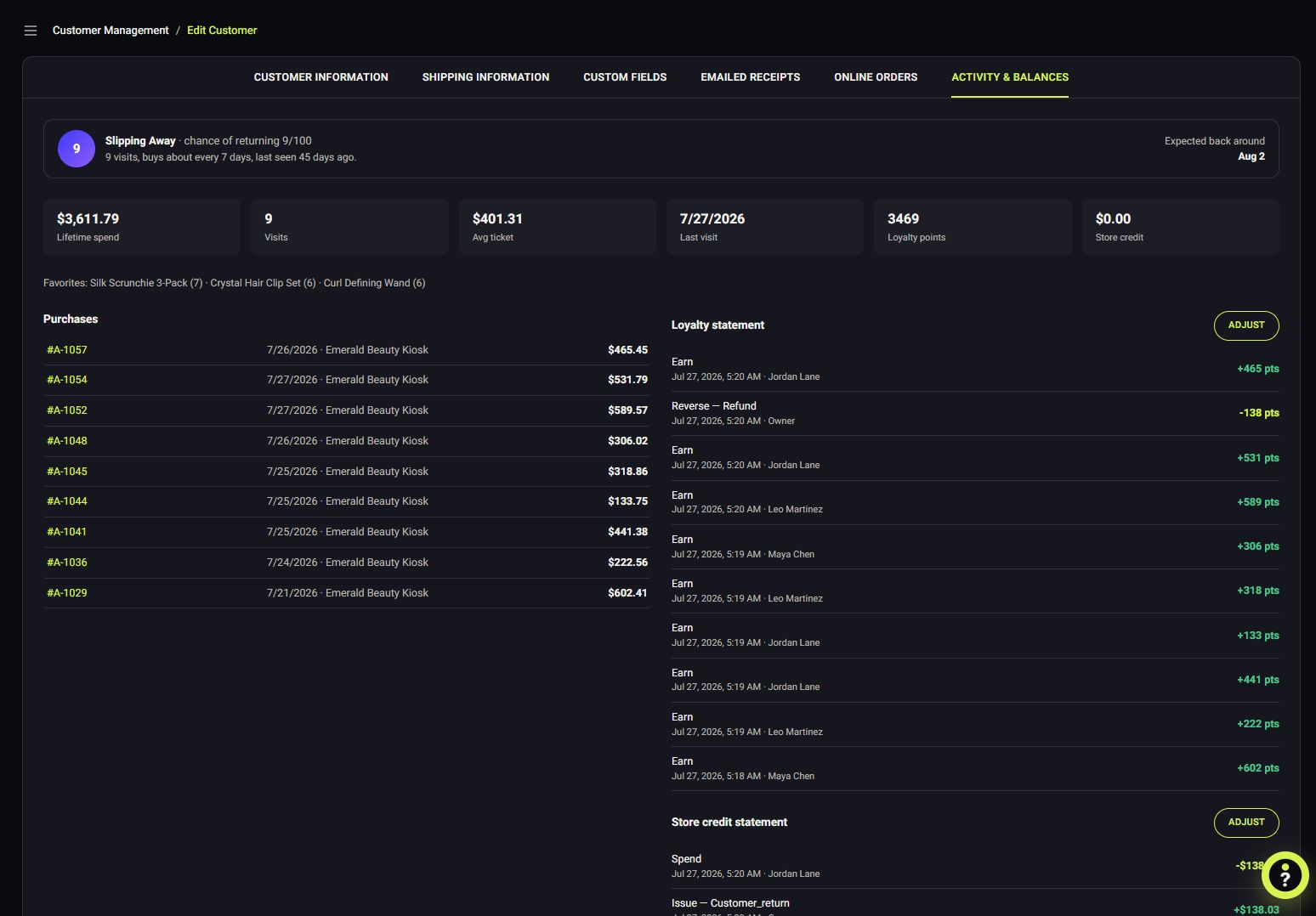
Win Back Lapsed Customers: 90 Days Is a Made-Up Number
The 90-day lapse rule is somebody else's default setting. Your real lapse window is a multiple of your own repurchase interval, and it changes by category.
The customer who bought incense and candles every three weeks for a year, then just stopped. Nobody in your store flagged it. Not because nobody cared. The day's total was fine the week she didn't come in, and the week after that, and every week since. A subscription company gets an email the moment someone cancels. A retail store gets silence, and silence looks exactly like a normal Tuesday.
Most advice on how to win back lapsed customers tells you to watch for anyone who hasn't bought in 90 days. That number gets repeated like a law of nature. It's the default window in a lot of email tools, and it's wrong for most stores in both directions at once. It panics you about a mattress buyer who's right on schedule, and lets your best coffee regular walk out the door for four months before anyone notices. That's different from winning a first-time buyer's second visit; this is about regulars who already gave you a dozen visits and quietly stopped.
It matters more than it looks. Frederick Reichheld's research at Bain, cited in Harvard Business Review, found that raising customer retention by just 5 percent can lift profits 25 to 95 percent. That's a lot of ground to give up to plain silence.
How do you know when a customer has lapsed?
A customer has lapsed once they've gone longer without buying than roughly two to three times their own normal gap between purchases, not a fixed 90 days. Coffee gets bought weekly; mattresses get bought every eight years. One flat number can't describe both. To win back lapsed customers before they're gone for good, calculate that multiple from your own sales data, per category, and reach out just before the threshold, not after it.
To win back lapsed customers, find your own number
Export a customer identifier and a purchase date for every transaction. If your POS keeps a running purchase history against each customer profile, the raw material is already there. VoVi keeps that history, so you're not building a database out of a shoebox of receipts.
Sort each customer's purchases by date and calculate the gap in days between each purchase and the next. In a spreadsheet, sort by customer then by date, run a formula like =B3-B2 down a third column for the gap, formatted as a number, then clear the gap cell on each customer's first row, because that one spans two different people. Run =MEDIAN() over what's left, the middle value, not the average. A customer with six purchases gives you five gaps, and you pool every gap in a category before you calculate.
The median matters because purchase gaps aren't tidy. Most customers cluster around a normal rhythm, then a long tail straggles back after a forgotten year. Average those together and one customer who returns after 400 days drags the whole threshold out with them. The median shrugs that outlier off. Multiply it by two to three for your lapse threshold: long enough that a slightly late customer isn't flagged as gone, short enough that you still have time to act.
A hardware store selling batteries and lawnmowers under one roof can't run this store-wide. Pool those gaps and the median describes no customer who actually exists. Split by department instead. Batteries and filters might run a nine-day median gap, tools and hardware four months, big-ticket appliances over a year. Each gets its own threshold, because each is a different relationship.
This is where the flat 90-day rule does its worst damage. Applied to the lawnmower buyer, 90 days of silence means nothing. Applied to the filter-and-battery regular, you've already lost three visits without noticing.
Contact before the threshold, not after
Say a category's median gap is 40 days. Your lapse threshold, at 2.5x, lands around 100 days. But the person worth contacting sits at 60 days, roughly 1.5x the median. They haven't switched habits, found a replacement, or decided they're annoyed at you. They just haven't been reminded. A message at that point is a nudge.
A message at 100-plus days is different work. You're reversing a decision already made, maybe for reasons that have nothing to do with you, like a move or a closer shop. Both contacts are worth making, but only one is cheap and reliable. Run two triggers if you can: a light touch at 1.5x the median, and a real win-back offer for the smaller group who slid past the threshold.
Pull the 1.5x list weekly rather than monthly. In a small shop it's usually a dozen names, and that's the point. A list that short actually gets read, and whoever reads it can cross off the two people who came in yesterday. A monthly list is long enough that nobody opens it twice.
What to send, and who not to send it to
A discount is the laziest re-contact message and the most expensive one. It works often enough to feel like a strategy, and every time it works you've taught that customer to wait for the next markdown instead of coming back at full price. Do it enough and your most loyal customers become your most discounted ones.
A better message is specific about what they actually bought: the restock on the tea they always get, the boot back in their size, the next book in a series they own the first four of. This only works if you know what they bought, which is the real argument for purchase history over a bare mailing list. A blanket "we miss you" email is guessing. A note about their last purchase is recognition, and costs nothing but attention.
Not every quiet customer is worth the message, though. Chase everyone equally and your re-engagement list turns into an expensive, annoying habit that trains people to ignore you.
- An out-of-town buyer whose billing address is nowhere near your trade area was passing through, not building a habit with you.
- Gift purchases: a single item bought once in December, never repeated, might not even belong to your actual customer. There's often just a relative on the list.
- Watch returns too. A purchase that boomerangs back within the week already told you how that "customer" felt about it.
None of these are lapsed customers. They're one-time transactions wearing a lapsed customer's clothes, and chasing them spends real money reminding a tourist about a store they'll never see again.
What the counter can do without any system at all
Not every store has clean exports yet, and the fix doesn't need one. A manager or a longtime seller usually already knows who they haven't seen. Keep a running note, paper or phone, and check it weekly instead of trusting memory alone.
The other habit is about when you ask for contact details, not whether you ask. Most stores ask at the register, mid-transaction, when the customer's already thinking about the door. Ask instead at the moment they're excited, the same read you'd use on a customer's second pass through the store: the last one in stock, or a customer asking if you'll get more. That's when "want me to text you when the next one comes in" gets a real yes.
Silence is the one customer signal nobody ever sends you. Every habit above is just a way of listening for it anyway.
Takeaways
- Calculate your own lapse threshold from purchase gaps in your sales data. Use the median gap, not the average, and multiply by 2x–3x.
- Do the calculation per category or department if you sell items with different lifecycles. A store-wide number will be wrong for almost everything you sell.
- The cheapest, most effective contact happens at roughly 1.5x the median gap, before the customer has decided anything, not after they've crossed the lapse line.
- Lead with a specific reference to what they bought, not a discount. A discount trains customers to wait for markdowns instead of returning at full price.
- Skip one-time tourists, gift buyers and return-bound purchases. Chasing them wastes the budget you need for customers who'll actually come back.
Common questions
How many customers do I need before a category median means anything?
Don't trust a category median built from fewer than about 30 pooled gaps, because a handful of customers can swing it wildly. Below that, fall back to your store-wide median until the category fills in. This is a rule of thumb from ordinary sales math, not a statistical guarantee, meant to get you close enough to act.
Should I reach out by email, text or phone?
Whatever channel the customer opted into, and only that one. Commercial email falls under the FTC's CAN-SPAM rules, including the win-back email you send to your own past customers: an honest subject line, a working opt-out, and a set window to honor it in. Text marketing carries its own consent rules on top of that, and a short text usually beats a mass email.
How often should I recalculate the repurchase interval?
Once or twice a year. Recalculate after any real shift in what you sell, whether that's a new product line, a supplier change or a pricing move. It's a snapshot of current behavior, and it moves when your assortment or prices do.