Your Retail Loyalty Program Rewards the Wrong Visit
Punch cards pay out on a visit you were always going to get. Build the program backwards from the second visit instead, because it is the only one worth paying for.
A woman buys $34 of earrings, taps her card and walks out. You will never see her again, and you never learned her name. Two minutes later a regular buys his usual, and your punch card hands him a free one, because that was his tenth.
You just paid the customer who was coming anyway. The one you might have won left for free.
A retail loyalty program that pays out on visit ten is buying behavior you already had. The visit still in play, the only one your effort moves, is the second. A first-time buyer walking out of your door is the cheapest future revenue you own, and almost nobody works it.
The tenth visit was never in play
Points programs with a distant threshold are a tax on your margin that buys almost nothing. Work out who collects: to reach ten visits a customer has to already be a ten-visit customer. You are not creating that behavior, you are paying a rebate for having noticed it.
Then there is what the reward teaches. A standing 10% discount tells a customer what your real price is: once they have had it, the shelf price is the fiction and they will wait for the discount. A $10 credit that dies in three weeks teaches a date instead. Nothing about what your goods are worth, only: come back before the 14th.
Credit also costs differently. A discount is certain, paid on every qualifying sale whether or not it changed a mind. Credit you pay only when somebody walks back through the door, which is the thing you were buying.
You get about one sentence at the counter
The capture window is the length of a card transaction. Six seconds, while the customer watches the reader and waits for the beep. One sentence, and it has to earn a name or a number attached to a specific purchase.
"Would you like to join our rewards program?" is the worst version of that sentence, and the one everybody uses. It asks for a decision at the moment the customer has mentally left. Nothing in it names a benefit, because "rewards program" is a category, not a thing anyone receives. What it does suggest is paperwork, and the polite answer to paperwork is no.
Sentences that work state the benefit first and shrink the ask to one field:
- "I'll text you the receipt, so you've got it if the strap goes. What's the best number?" They get proof of purchase for a warranty claim. You get a number tied to an item.
- "I'm putting five dollars on your name for next time, good for a month. Name and number?" The reward is stated as already done, not offered. There is nothing to decline.
- "Want me to note you're a 7.5 in this brand? Saves you trying them on next time." For anything with a size, a fit or a refill cycle.
Notice what none of them contain: the word "program". It matters more on a cart than in a store, because there is no shopfront to wander back into by accident — kiosk and cart operators depend on being found again on purpose.
Design your retail loyalty program backwards from visit two
The outcome you are buying: one more visit from someone who has already proved they will pay you.
- One threshold, and it is visit two. Whatever you were spreading across ten visits, concentrate on the gap between the first and the second — the only one where the customer has not yet decided.
- Put a date on it. Two to four weeks: long enough for a normal buying cycle, short enough to compete with this month rather than someday. The date is what you are buying.
- Tie it to the receipt, not a card. Cards get lost, left at home, thrown out with the bag. A texted receipt sits in the customer's pocket with your name on it.
- Point the reward at what they bought. Credit against the same category reads as a suggestion rather than a rebate.
- Price the payout first. Ten to fifteen percent of the first sale is a sane landing zone. On the $34 earrings that is $3.40 to $5.10 — round it to the $5 you already say out loud. At a 50% gross margin that sale made about $17 of gross profit, so you are handing back under a third of it, and only to the customers who come back.
None of this needs a loyalty vendor or a plastic card order, only a till that holds a customer record and finds it by phone number — ordinary now, including in free POS software. Count the credit you expect redeemed plus what software and card processing cost you, and you know what the second visit really cost.
Store credit is a second visit you have already booked
The National Retail Federation asked 358 ecommerce professionals at retailers above $500 million in revenue what returns cost them, and got 15.8% of annual sales, about one dollar in six of what those merchants sell, or $849.9 billion of merchandise going back across US retail. Every refund handed back across your counter arrives with a live customer attached, and most owners see only the loss.
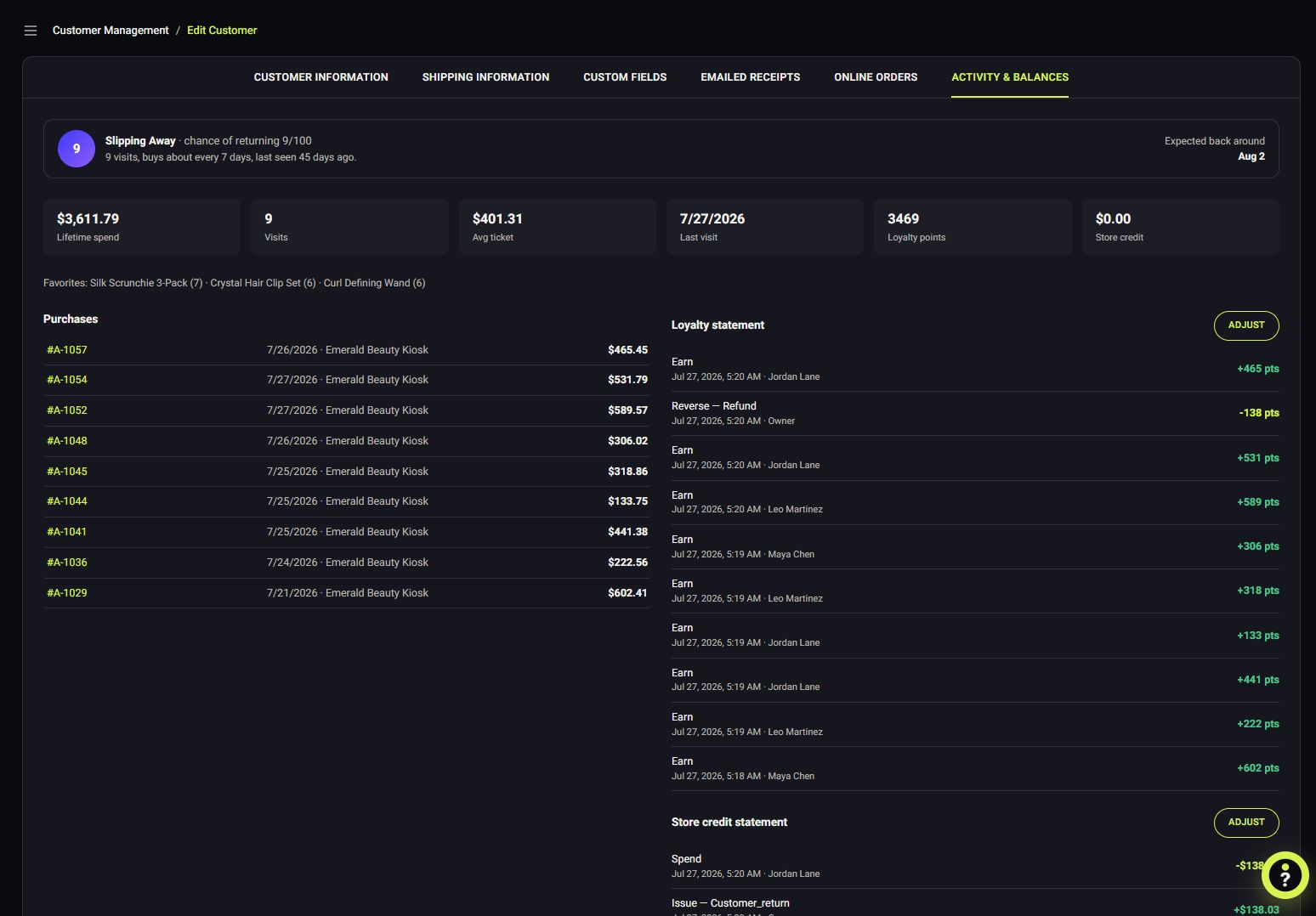
A cash refund settles the account and ends the relationship. Store credit ends the transaction and keeps the relationship, booking a second visit while the customer is still in front of you, and in practice it tends to get spent above face value, because almost nobody finds something priced at exactly $46. What they want at that counter is speed. On a card sale the refund takes days to land; credit is instant.
Two rules if you default returns to credit. Post the policy where a customer reads it before buying, not after; a credit-only rule that surfaces when somebody asks for their money back is an argument you lose twice, at the counter and again in a review. And attach the credit to the person, not to a slip of paper — in VoVi it is a balance on the customer record, visible to anyone on shift.
The gift card in your till was paid for by somebody else
Somebody bought a $50 card and the cash is already in your drawer. The person who redeems it is usually someone you have never met, introduced by a customer who trusted you enough to spend money on your behalf — a warm referral with the money pre-loaded, and most shops treat it as admin. In my experience it is the best acquisition moment you get all month, because the money already feels spent and people trade up when it does.
The accounting argues for redemption too. Under the federal rules implementing the CARD Act, funds on a gift card cannot expire sooner than five years from issue or last load, so the liability sits on your books for years. The balance is not reliably yours either: many states treat unspent value as unclaimed property after three to five years, others exempt it, and the state administrators publish a state-by-state list. Breakage is not a business plan.
So work the redemption like a first visit. Same sentence, same capture. If there is a balance left, put it back on their name and say the number out loud. "You've got eleven dollars left on this" is a date you just set.
Welcome back is worth nothing
The second visit is where this turns into a relationship or stays a discount, and the greeting decides which. The customer knows the screen told you her name. "Did the blue one hold up?" could only come from a record somebody bothered to keep.
You do not need to remember anyone. You need the last three lines of their purchase history on screen the moment the phone number goes in — in VoVi it sits on the customer profile. Two seconds of reading is the whole trick.
Rule for the floor: read it before you speak, and use exactly one thing. Two is surveillance.
What to do on Monday
- Move the whole loyalty budget onto one threshold: earned on visit one, spent on visit two, expiring in two to four weeks.
- Ban "would you like to join our rewards program?" Replace it with a benefit first and an ask for one field.
- Default returns to store credit, issue it against the customer record, and post the policy before the sale.
- Treat every gift card redemption as a first visit by a customer somebody else paid to introduce.
- Put purchase history where the person at the counter can read it, not only in the owner's reports.
None of this is a program in the usual sense. No tiers, no plastic, no app. The tenth visit looks after itself, because anyone who came back twice is already coming back.