The Retail Referral Program Most Shops Never Build
The receipt line rarely works. The ask that does takes five seconds and one specific customer.
“Refer a Friend — Get $10 Off” has been printing on the bottom of your receipts for three years, maybe longer. Nobody behind the counter has ever been told to say a word about it out loud, and you can’t tell me how many times it’s been redeemed — because a line of small print isn’t built to be tracked.
That’s the standard retail referral program: a vague discount, aimed at everyone who happens to glance down while the paper prints. It costs nothing to set up and returns almost nothing, because it skips the two things that make a person recommend you to someone: being asked, by a person, at a moment when the recommendation is true.
Word of mouth is already doing more work for you than you’re crediting it for. In a 2013 Nielsen survey of online respondents across 58 countries, 84 percent named recommendations from friends and family the most trusted form of advertising there is, ahead of every paid channel Nielsen tested (Nielsen, Global Trust in Advertising). Word of mouth beats paid advertising outright in some categories — more than twice the sales, in fields as far apart as skincare and mobile phones (Jonah Berger, on the McKinsey word-of-mouth research). None of that requires a program. A referral system just gives you a way to ask for it on purpose, and to pay for it only when it produces a sale.
What’s a good reward for a retail referral program?
Store credit or points worth roughly 10 to 20 percent of an average ticket, paid to the referring customer only after their friend completes a first paid visit, works better than a flat cash discount. It costs you margin dollars instead of cash from the drawer, and tying it to a completed sale means you never pay for a name that goes nowhere.
Ask your regulars, not your whole customer list
A referral offer blasted to your entire mailing list is a coupon with extra steps. The people worth asking have an actual relationship with the shop: five or more visits in the past year, a purchase history that shows they keep coming back for a specific thing, or a big-ticket purchase they were visibly happy with. That’s usually a small slice of your customer base — the same customers your loyalty program should have been paying for at visit two, if you’re paying attention to who comes back.
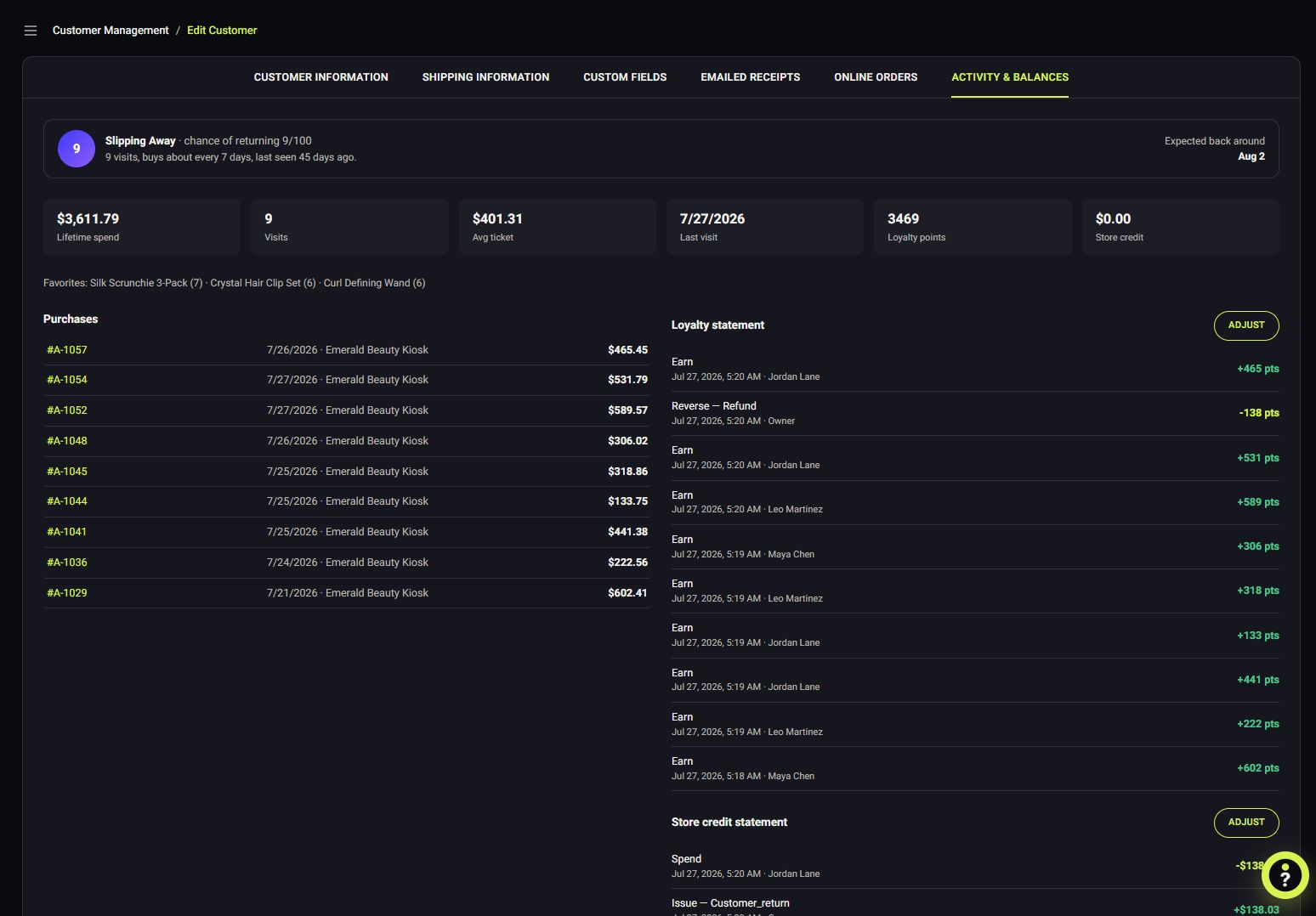
Pull that list before you decide on a message. If your point-of-sale system keeps purchase history per customer — VoVi’s customer profiles show it by default — this is a ten-minute filter. Rank them by visit count, then by what they’ve spent with you, and start at the top of both lists. Those are the customers whose friends are worth having: people with money to spend and a taste that already overlaps with your shop, introduced by someone who likes the place enough to say so.
A Journal of Marketing study that tracked roughly 10,000 customers of a German bank for nearly three years found referred customers were worth at least 16 percent more over their lifetime than comparable customers acquired without a referral, matched for demographics and signup date. Their contribution margin ran higher too, though that edge narrowed over time; their retention advantage held (Schmitt, Skiera & Van den Bulte, 2011). On the numbers, a referred customer starts out worth more than someone who found you cold.
Ask right after something goes well, not at checkout on a random Tuesday
The receipt-line ask fails because it’s disconnected from any real moment. The ask that works happens right after a customer has just had a good outcome: the tailor got the fit right on the second try; the bike shop found a rattle nobody else could diagnose. Or she’s standing at the counter holding the gift wrap, and it looks exactly like she pictured it. That’s the five seconds where a customer would probably tell a friend about you anyway — you’re just giving them a reason to do it today instead of maybe next week, maybe never.
For staff on the floor, the ask is a sentence you say to the specific customer who just told you “this is exactly what I wanted,” or who came back a second time to thank you for a fix. Something as plain as “if you know someone who’d love this, send them in and mention your name — you’ll both get store credit” costs nothing to say and sounds like a favor, said in passing. That’s the same instinct behind timing a second approach on the floor: watch the room, don’t run a script.
Reward it too well and you’ve built a salesperson who doesn’t know it
A $50 reward for a referral that nets a $40 sale is a losing trade, but the more common mistake runs the other way: a reward generous enough that a regular starts treating a recommendation as a transaction of its own, working acquaintances for referral credit instead of mentioning you when it happens to be true. Once the reward is worth chasing on its own, the recommendation loses the thing that made it work: a real customer vouching for a friend, said because it’s true.
Cap it around 10 to 20 percent of an average ticket, per customer, per quarter. That ceiling is enough that a regular bothers to mention it, and rarely enough to be worth cold-pitching strangers. Because it’s paid in store credit rather than cash, you’re spending out of margin instead of your drawer — a $15 credit against a $60 average ticket costs you the wholesale price of the goods it buys, not $15 in cash gone for good.
Track who sent whom, or you’re back to hoping
The receipt-line approach fails a second way, even on the rare redemption: there’s no record of who sent whom, so there’s no way to tell whether the program is working or just costing money. At minimum, log the referring customer’s name against the new customer’s first sale — a note by the register if that’s what you’ve got, a field in a customer record if your system keeps one.
After a full quarter, pull that log and look at three things: how many referrals converted to a paid visit, what they spent on average against your normal ticket, and which regulars are doing the referring more than once. That third number matters as much as the first two — a customer who sends a second or third friend has become a channel, worth thanking outside the formal program entirely, maybe with something the standard reward never covers. If a full quarter produces only a handful of completed referrals, the ask itself is the problem — go back to who you’re asking and when, before you touch the reward.
The shops that get referrals this way don’t have a better offer than the receipt line down the street. They’ve just made asking part of somebody’s job, instead of hoping a line of small print would do it for them.
Building a retail referral program that pays for itself
- Ask your top 5 to 15 percent of customers by visit count or lifetime spend — a mailing-list blast is a coupon.
- Time the ask to a specific good outcome, right after it happens.
- Pay in store credit or points capped around 10 to 20 percent of an average ticket, released only after the new customer’s first paid visit.
- Keep the reward small enough that recommending you stays a favor.
- Log who referred whom for at least a quarter before deciding whether the program earns its keep.
Common questions
Should the reward go to the new customer too, or just the person who referred them?
A split works better than rewarding only one side. Giving the new customer a smaller welcome credit, maybe half of what the referrer gets, lowers the friction of showing up somewhere new and gives them something too. Keep the referrer’s share larger, since they’re the one taking a small social risk on your behalf.
Does a referral program work for a mall kiosk or cart with no guaranteed repeat traffic?
A kiosk or cart running off a tablet can’t count on the customer walking back past the counter, so the ask and the reward have to happen inside the same conversation as the sale. Collect a phone number or email at checkout and send the referral code immediately, while the good outcome is still fresh — don’t wait for a next visit that may not come.
What happens if the referred customer returns everything after I’ve already paid out the credit?
You’ve paid for a completed sale, and store credit doesn’t reverse itself if the transaction unwinds later. If it happens more than once or twice, change the trigger from “first sale” to “first sale that survives your return window” — typically 14 to 30 days. Most shops never need to make that change.