How to Clear Dead Stock: One Cut, Not Eleven Months
The stair-step markdown is the most expensive habit in small retail. Once an item is dead, the price is whatever a stranger will pay today — so cut once, and cut deep.
There is a box in your stock room you step over. You know what is in it. You knew six months ago, and the ticket on those units has been cut three times since, and there are still — what, thirty of them? Forty? You stopped counting, because counting would mean deciding.
That box is dead stock, and it isn't sitting there because you're lazy. It's there because every markdown you took felt careful. Ten percent off. Then twenty. Then thirty. Each step was small and reversible, and together they are the most expensive habit in small retail.
Slow and dead are different problems
"It hasn't sold" is not a diagnosis. Good items go quiet for three weeks, then move ten in two weeks because the weather turned. You need the rule set in advance, so the call isn't made by mood at 9pm on a Sunday.
Start with days of supply: units on hand divided by average units sold per day over the trailing eight weeks. Forty units moving at 0.2 a day is 200 days of supply. The Census Bureau runs the same sum on the whole sector in its retail inventories and inventories-to-sales ratios. Fewer zeroes, same question.
Compare that to the life the item has left. A summer item in mid-July has maybe fifty days; a core line that will still be in the assortment next spring earns ninety. Here's the threshold I'd start with, and I'd rather you argue with it than skip it: dead means days of supply at twice remaining life. Two hundred days of supply on that summer item is four times the life it has left and twice the trigger. Move the multiple if your own buys say so, but pick one today and write it down.
Then check sell-through against its cohort. If the rest of that order is at 60% and this one is at 12%, it isn't the season. It's the item. Which is why inventory turns tell you more than units sold. One exception: an item that spent a season behind the register hasn't been tested. Give it four weeks at eye level on a main run, then re-run the days-of-supply sum from that date.
Every facing pays rent
The markdown is not the cost.
Treat every facing as a tenant, and the rent is sales per facing per week. This facing does $70 a week. That one does $45. That one does $6. The $6 tenant hasn't been evicted because he technically still pays. He pays under a tenth of what the space is worth, on a lease you renew every week by not deciding.
The rent roll takes an hour, not a project. Pull item-level sales for one ordinary week, not a holiday, not a promotion. Count each item's facings on one wall, divide the week's dollars by them, and rank twenty items. The bottom three are the conversation.
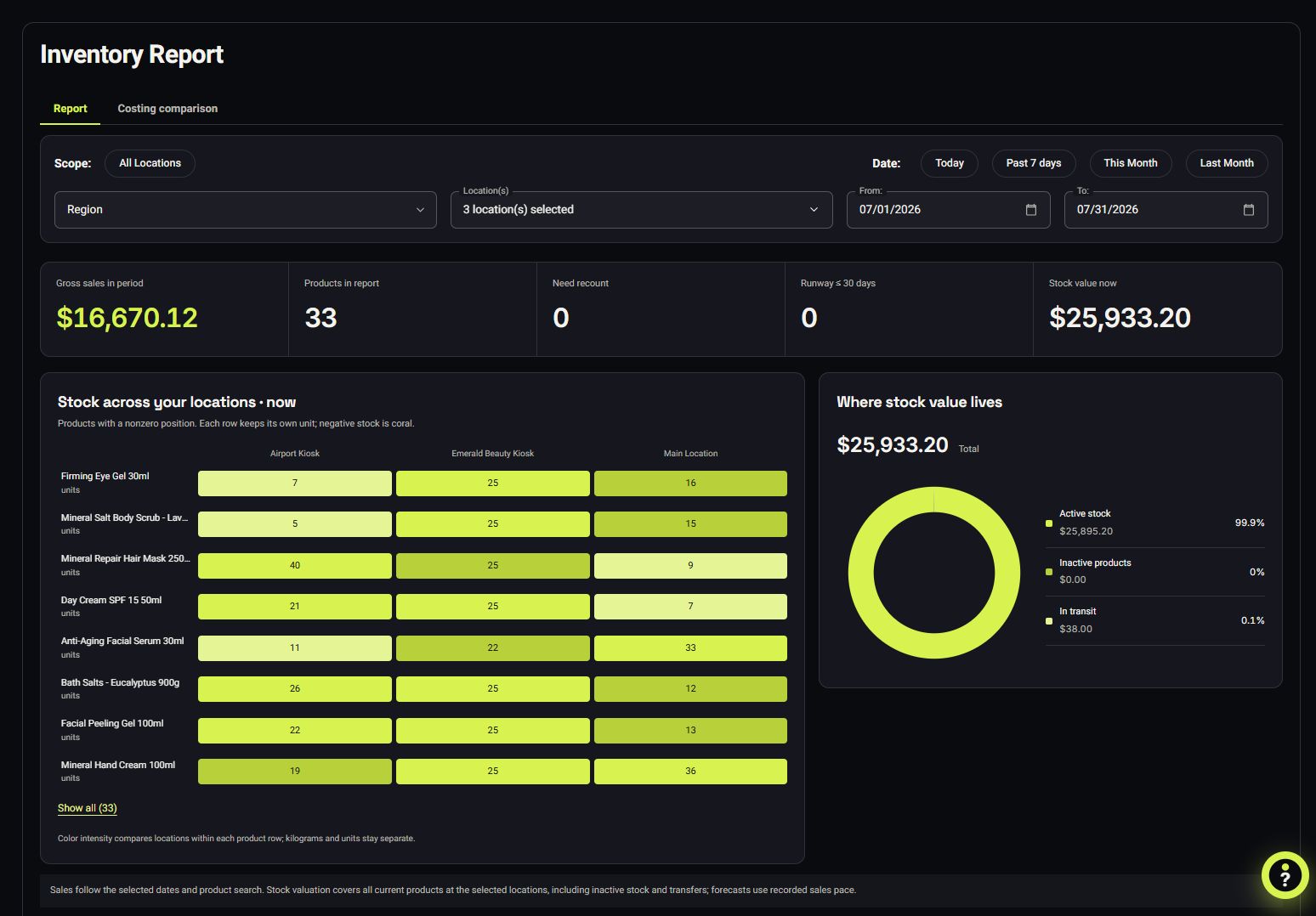
Then there's the cash. You paid $12 a unit and have 40 left: $480 parked in a carton. If the stuff that actually sells in your store turns its cost value three times a year at keystone, that same $480 would have done roughly $2,880 in sales and $1,440 in gross profit. The loss isn't the discount you're avoiding; it's a year of work $480 never did. Retail has a name for the question, gross margin return on inventory investment, and its premise is the argument: capital that isn't working is losing.
How to clear dead stock in one cut
Work backwards from two numbers you have: units on hand, and the days you'll give them. Forty units in thirty days means 1.3 a day. Ask what price makes a stranger pick that thing up 1.3 times a day. Not the price you'd like. Go a step past it. The punishment for overshooting is that it's gone by Friday.
The arithmetic that makes people uncomfortable: ticket $29, cost $12, forty units left, $480 in that box whichever way you go.
- One cut to $15. Forty units gone inside the thirty days. $600 in the drawer, minus $480 of cost, is $120 of gross profit in one month, and the facing is back in service before the next order lands.
- The ladder. Ten percent off moves three at $26.10. Twenty moves four more at $23.20. Thirty moves five at $20.30. Eleven months later the last twenty-eight go in the bin by the door at $9, under cost. The lot takes $524.60, minus the same $480: $44.60 of gross profit for eleven months of renting a facing to a non-payer.
$120 in a month against $44.60 in eleven months. That is the entire argument, and it is not close.
The customer who would have bought at 20% off already walked past it at 20% off for four months and kept walking. And waiting makes clearing harder: the Management Science paper on clearance pricing and inventory policies for retail chains builds in how sale rates fall as the assortment thins.
The clearing price is often below cost. Take it on purpose: that $480 left the building the day you paid the invoice, and holding the line at $23.20 won't bring it back.
Where the goods actually go
Not the back of the store. A clearance corner at the rear gets dead stock forgotten twice. Put the cut goods in traffic, and set the end date the day you start: an offer that outlives its window quietly becomes your new price.
- Bundle it to something that already sells. Band the $29 item you just cut to $15 to the fastest mover on the same wall. If that mover is $35 alone, price the pair at $42, $7 over the mover's own ticket. Be honest about it: the customer was buying the mover anyway, so you take $7 on the dead unit instead of the $15 a straight cut brings, $5 under cost. You do it because it needs no clearance sign, no decision from the shopper and no floor space.
- Give it away above a threshold. "Spend $50, pick one of these free" recovers nothing on the unit and everything on the shelf. Set the threshold just above your current average ticket: if you average $41, the trigger is $50, not $35.
- Pay your team to move it. A flat $2 a unit on a named list of dead SKUs beats any sign, and it's the rare spiff nobody games badly: the money stops when the SKUs are gone. More on what commission should reward is in our commission piece. If your POS runs the spiff for you — VoVi tracks commissions and staff competitions — nobody tallies it by hand on Sunday.
- Sell the lot. A jobber, a discount reseller, a store two towns over where the item is new. Fifty cents on the dollar of cost ($6 a unit against the $12 you paid), one transaction, one afternoon. The buyer isn't fleecing you; he's buying a problem you've proved you can't solve.
Per unit, you recover $15 on the straight cut, $13 after a $2 spiff, $7 in the bundle, $6 from the jobber and $0 giving it away. Read that as dollars recovered, not best to worst: the cheap routes buy speed, borrowed demand and an empty facing, which some weeks is worth more than the dollars. I'd cut the ticket first every time, and use the bundle, the giveaway and the jobber on what the cut leaves behind.
The second buy is the real test
First-week sell-through lies. Week one gets the novelty, your staff's enthusiasm, and the regular who buys three of anything you put on the counter. The honest test is the first reorder: does it sell at that rate once nobody in the building is excited?
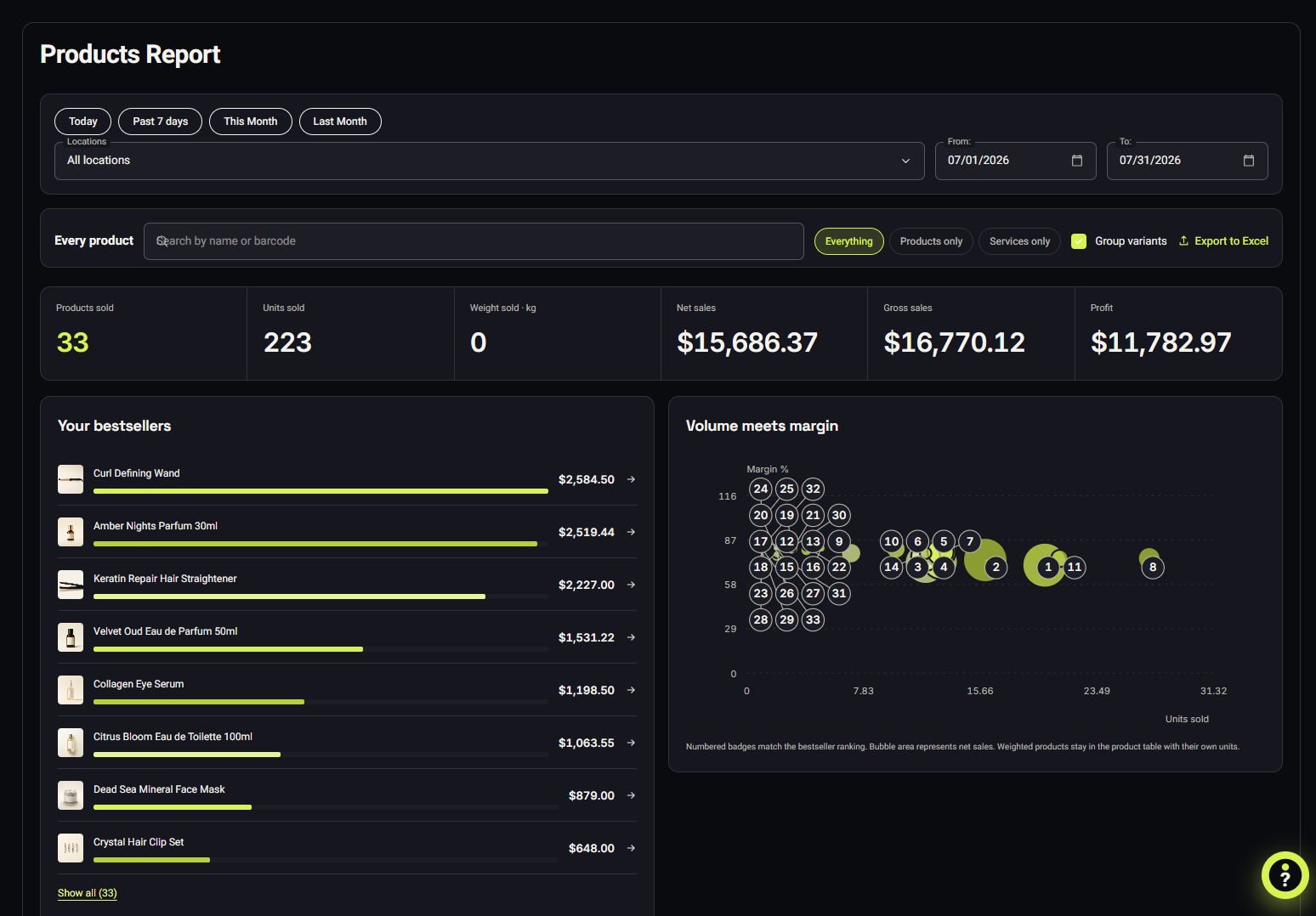
So make a rule: no second buy without a sell-through number on the purchase order. Not "it did well": a percentage and the weeks it took. If you can't produce it you aren't reordering, you're gambling while a rep watches. VoVi's free POS keeps a stock ledger per item and per location, which is mostly useful for exactly this moment.
Buy narrow and deep, too: eight SKUs at ten units each beat twenty-five at two; a sample of two ends the season as orphans too small to clear. The display side of that is in our kiosk layout piece.
Cheapest habit there is: write a kill date on the receiving document the day the goods land. Future you, standing over that box in October, won't make the call. Past you can, in four seconds, with a pen.
What to do with this
- Define dead in advance: days of supply at twice remaining life, plus sell-through against the rest of the buy.
- Price backwards from units on hand ÷ days you'll give it, then go deeper than is comfortable.
- One deep cut empties the box in a month and returns 2.7x the gross profit a slow ladder squeezes out over eleven.
- Move goods through traffic: bundles, gift-with-purchase, a spiff, a bulk lot. Never the back corner.
- No reorder without a sell-through number on the PO, and a kill date on every receiving doc.
The bin by the door is not a clearance strategy. It's a museum of decisions you haven't made, and admission is free for everybody except you. Pick the number tonight, cut once, and let a stranger tell you by Sunday what the stuff was actually worth.