How to Upsell at the Register Before the Card Comes Out
“Anything else?” is a closing question aimed at somebody who already closed. The fix is not a better script, it is making one specific offer about ten seconds earlier.
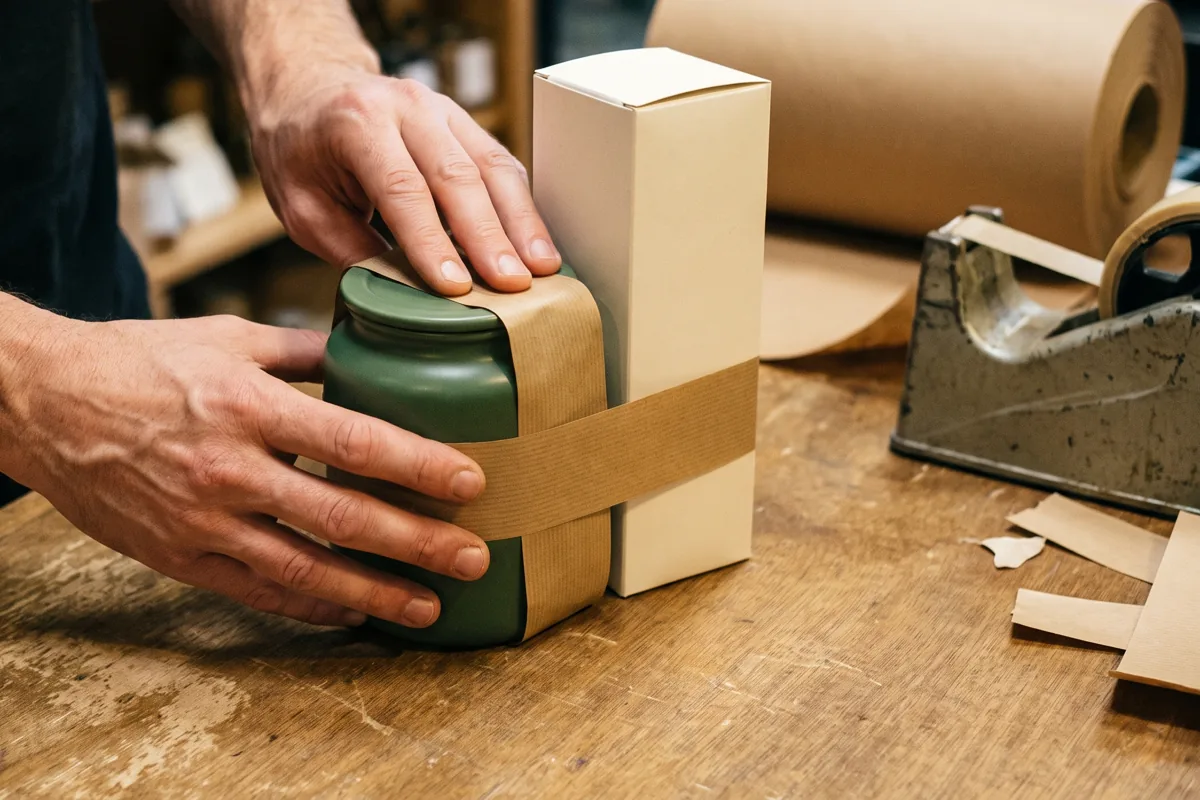
A woman at a mall cart in Columbus picks up a $68 hooded sweatshirt, turns it over twice, and says, “I’ll take this one.”
The seller folds it, drops it in a bag, rings it up, and asks, “Anything else for you today?” She says no. She was always going to say no.
There was a $9 beanie in the same knit eighteen inches away. She’d probably have bought it. Nobody offered it to her. She was offered a question.
Almost everything written about how to upsell at the register is about what to say. Almost none of it is about when, and the when is where the money goes. That seller didn’t use the wrong words. He used them about ten seconds too late.
“Anything else?” is a closing question
“Anything else?” is a closed question with two answers on offer. One of them is “no” — free, polite, one syllable, and it ends the conversation. You built the exit and pointed at it.
The second problem is bigger. The question asks the customer to inventory your merchandise from memory and choose from it. That is your job, handed to someone who cannot see half of what you stock.
Replace it with a sentence that does the work: name one thing, tie it to what they chose, say the price before they ask, and finish on an action rather than a decision.
“That beanie’s the same knit as the hoodie. It’s nine. Want me to drop it in?”
“Want me to drop it in?” is a question about a bag. “Anything else?” reopens a total they had made peace with. Nothing is hidden, either — the price was said before they had to ask for it.
The window closes when the card comes out
The most valuable moment in a transaction is the yes to the first item. Someone who has just agreed to something is likelier to agree to the next thing — the foot-in-the-door effect, out of Freedman and Fraser’s 1966 experiments.
Once the customer reaches for a wallet they have changed jobs. Choosing and paying are different tasks, and paying is the defensive one: the total is on the screen, and a new item reads as an attack on a figure already accepted.
Make the rule physical. Where the item is tells you where you are.
- Still in your hands — in time. Say it now.
- In the bag — late. You now need a reason to reopen it, and “anything else?” is not one.
- Card on the counter — done. Take the money and say something nice.
If it’s in the bag, you’re late. On a kiosk or a mall cart, where the counter is two feet deep and nobody sits down, the window is often one sentence wide.
The rule of proportion
Tversky and Kahneman’s 1981 framing paper asked people whether they would drive twenty minutes to save $5 on a calculator. When the calculator cost $15, 68% said yes. When it cost $125, only 29% did. Same five dollars, opposite answer. Nobody judges a price in absolute terms. The brain is a percentage-of-change detector — the Weber–Fechner law in its cheapest retail form.
The paper doesn’t give you a number. Here’s mine, and I’ll defend it. Keep the add-on under about 15% of what the customer has already committed to, and treat 25% as a wall. Under 15% it registers as rounding, and rounding is a feeling rather than a decision. Past 25% they stop weighing the add-on and reopen the basket — and then you are not defending a $9 beanie, you are defending $68.
A $12 phone case is easy against $95 headphones (13%) and nearly impossible against a $19 charging cable (63%). If you have been told you are bad at upselling, check what you have been attaching to before you accept the verdict.
How to upsell at the register: one item, named and priced
A menu is a research project. “We’ve got cases, screen protectors, cables and a car mount” drops the customer into comparison shopping at the moment they decided to be finished, and comparison shopping under time pressure produces nothing.
So pre-decide. Take your top five to ten sellers by unit volume — volume, not revenue, because volume is how often the sentence gets said — and write one attachment beside each. One. Price it. Write out the sentence. Tape the card where the seller can see it and the customer cannot.
| What they’re buying | The one attachment | Price | Share of the base |
|---|---|---|---|
| $68 hoodie | Beanie, same knit | $9 | 13% |
| $34 phone case | Tempered-glass screen protector | $7 | 21% |
| $120 wireless headphones | Hard travel case | $16 | 13% |
| $54 crossbody bag | Leather-care wipes | $6 | 11% |
| $22 candle | Box of long matches | $4 | 18% |
The last column is not decoration. Fifteen percent is the target, not a fence: the matches at 18% still land most nights. The screen protector at 21% is the row that fails most often, and a $5 protector would close well enough that the extra two dollars are not worth keeping.
Attach rate, and the arithmetic that follows
Two ways to count it. Items per transaction is total items over total transactions, and it gets flattered by the customer who buys six of the same candle. Use the other one: the percentage of transactions holding two or more items, which counts how often somebody made a second decision.
Say a cart does 420 transactions in a week and rings 524 items: 1.25 items per transaction. Of those 420, 96 held two or more items — a 22.9% attach rate. Put the card under the register and work it to 30%, and that is 126 transactions with an add-on instead of 96, thirty more a week. At an average add-on of $11: $330 a week, a bit over $17,000 a year, on stock you already own. At a 60% margin, roughly $10,300 of it is gross profit.
None of that comes out of a drawer total; it needs the line-item history per transaction that a cash box cannot give you and a basic POS can.
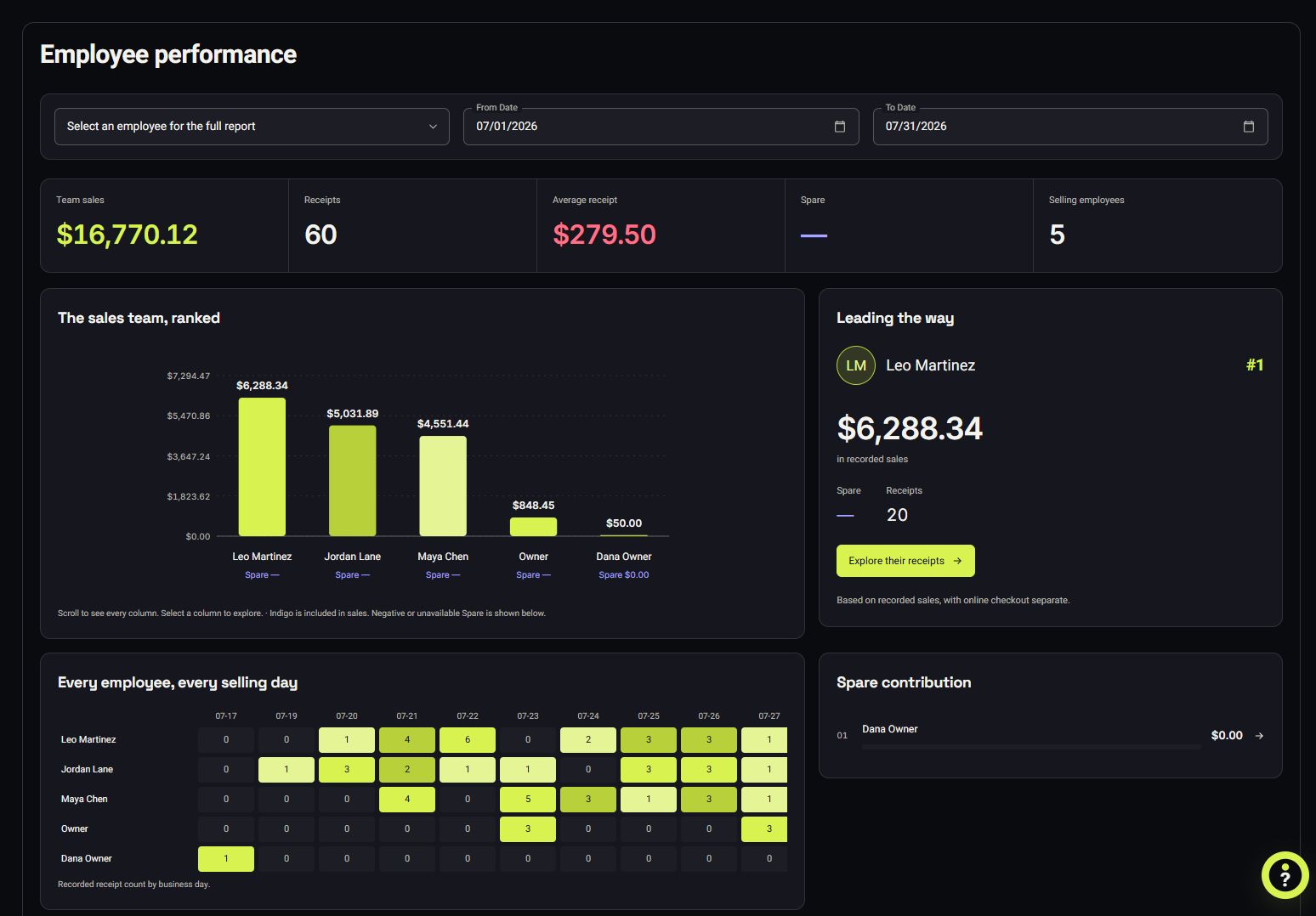
Then pull the number per seller, or do not pull it at all. Two people on the same cart, working off the same card, will not land within ten points of each other, and the gap is nearly always the sentence, not the personality. Your POS should give you net sales and a transaction count against every name on the rota — VoVi reports that under Sales by Employee in the back office — and a printed gap ends the “she’s just better with people” argument.
The three people you don’t pitch
Knowing when to say nothing is what separates a seller from a script. The standard advice — ask every customer, no exceptions — is wrong, because a bad attempt is not free.
The one who has already left
Keys in hand, phone up, “just this.” The pitch costs you nothing you were ever going to get — it costs fifteen seconds at the front of a line, where someone at the back is deciding whether the wait is worth it.
The gift buyer who already stretched
They walked in thinking $30 and committed to $75 because it was right for the person. That is relief, not momentum. Offering more reopens a decision they are quietly anxious about, and anxious decisions come back as returns.
The flincher
They asked the price twice, or turned the tag over, or said “how much was that again?” That is somebody at the edge of their number, not somebody negotiating. Add to that total and you do not lose the add-on, you lose the $68 — at the counter, or at the returns desk three days later.
The related failure is buying the attachment with a discount: $10 off the hoodie to move the $9 beanie. You gave away ten dollars to earn nine, it felt like a win, and you will do it again next Saturday. Set a floor price per product so the negotiating room is decided in an office, not at 8:40 on a Saturday night. VoVi has per-product minimum price floors, and every feature is on every plan.
What to change tomorrow
- Retire “anything else?” Name one item, say its price, finish with “want me to add it?”
- Offer while the item is still in your hands. In the bag is late; card out is over.
- Keep the add-on under roughly 15% of what they already committed to, never past 25%.
- Pre-decide one attachment, with price and sentence, for each of your top ten sellers by unit volume.
- Track transactions with two or more items weekly, per seller. Coach the sentence, not the person.
None of this is charm. Charm is what people call it afterwards, when the seller who pre-decided her offer, priced it properly and made it before the wallet opened is running eight points ahead of everyone else on the same cart.